Radish vs Yuka: Two Apps, Two Different Jobs
In short
Not entirely. Radish shows the Nutri-Score and 11 vitamins and minerals when the data allows, which covers a good part of the need. But Yuka keeps two unique strengths: its additive rating and its cosmetics analysis.
"Radish or Yuka?" is the wrong question. Yuka tells you whether a product is good the moment you scan it in the store. Radish tells you what you actually ate over the day, the week, the month. Two different jobs — and plenty of people use both. Here's what each one really does, without forcing the comparison.
What Yuka does (very well)
Yuka is the supermarket reflex: you scan the barcode, you get a score out of 100 with a colour code, for both food and cosmetics. Its database covers roughly 4 million food products and 2 million cosmetics. For food, the score breaks down into three parts: 60% nutritional quality (calculated using the Nutri-Score method), 30% additives (an additive judged high-risk caps the score at 49/100) and 10% organic.
And it has to be said: the model is clean. No brand pays Yuka, no ads, no data resale. Scanning is free and unlimited; Premium is a pay-what-you-want support tier (from around €10/year) that unlocks offline mode, the search bar and unlimited history. It's a respected app, and deservedly so.
What Yuka doesn't do: the journal
Yuka rates products, not your days. There's no food journal, no calorie counter, no macro tracking: once a product is scanned and judged, the app has done its job. That's a deliberate choice, not a gap — but if your question is "did I get enough protein this week?" or "how am I doing on iron?", Yuka can't answer that.
That's exactly where a food journal's job begins. If you're looking for that kind of app, we compared the options in our guide to free MyFitnessPal alternatives.
Ready to try Radish?Private calorie counter, Nutri-Score, no ads. Free.Get Radish →What Radish does
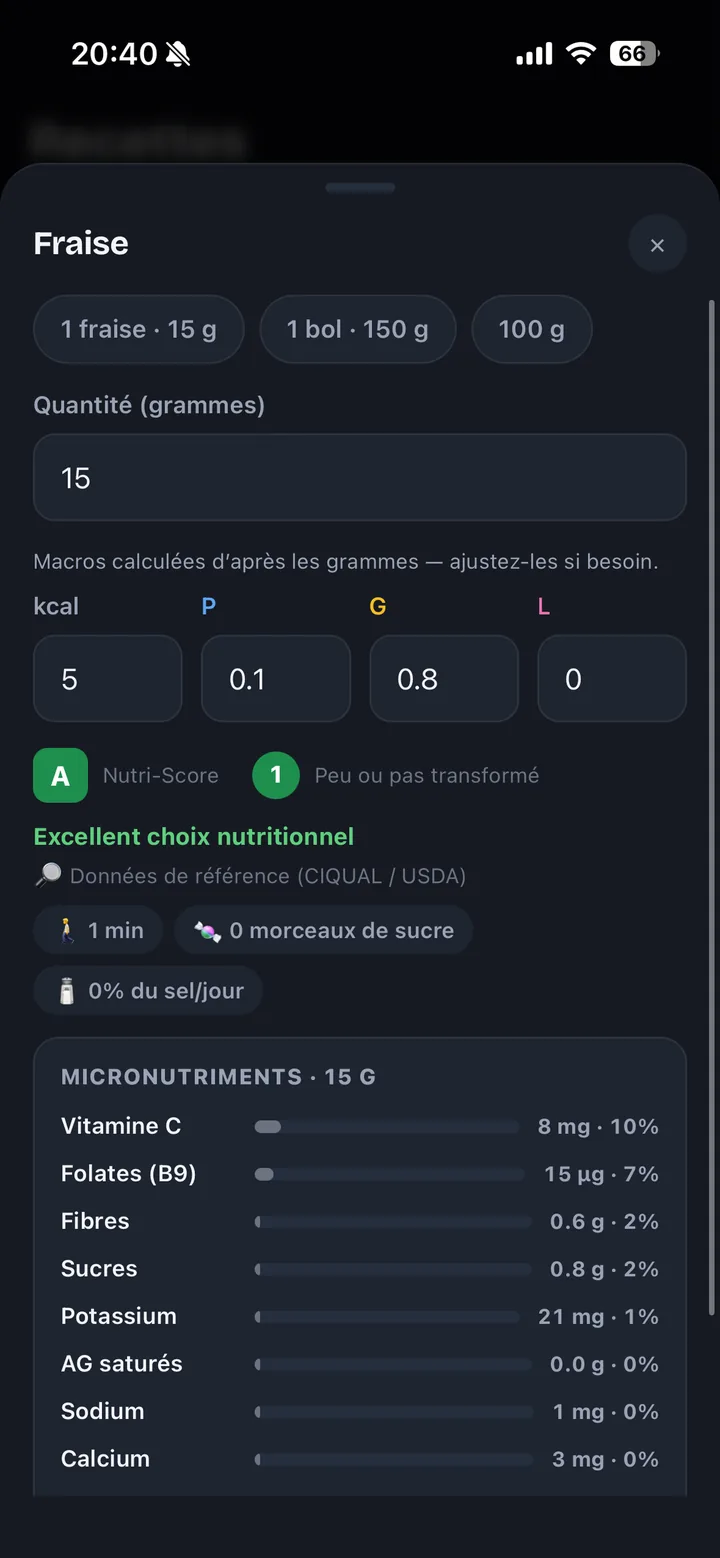
Radish is a complete food journal: you log your meals (barcode scanning included, free), and the app tracks your calories, macros and 11 vitamins and minerals from sourced data (CIQUAL/USDA). Every food shows its Nutri-Score from A to E — the real official letter, computed with the revised 2022-2023 algorithm (French decree of 14 March 2025), not a homemade score. You can also create your own recipes and follow your weekly averages. If the goal is simply eating well day to day, our eating well, day to day guide picks this up.
On the model side: free, no ads, no account, counting that works without a connection, and your diary stays on your phone — never sent to our servers (except AI or barcode scanning, if you use them): scanning a product missing from the database queries Open Food Facts, and AI meal analysis, if you use it, sends the meal's text or photo to our provider, after your explicit consent. Where Yuka judges the product on the shelf, Radish adds up what actually ends up on your plate.
Radish vs Yuka: the table
Checked in July 2026 against Yuka's official pages — offers may change.
| Criterion | Radish | Yuka |
|---|---|---|
| Main use | Food journal: calories, macros, micros day to day | Rating product quality at the scan (food + cosmetics) |
| Food journal? | ✓ meals, recipes, weekly stats | ✗ no journal or calorie counter |
| Free scanning? | ✓ via Open Food Facts | ✓ unlimited |
| Nutri-Score? | ✓ A to E letter shown when the data allows | ~ method built into its 100-point score (60% of the score) |
| Micronutrients? | ✓ 11 vitamins and minerals tracked (CIQUAL/USDA) | ✗ no tracking of your intake |
| Offline? | ✓ log counting works without a connection | ~ Premium only |
| Account required? | No, ever | Yes, sign-up required |
| Price | Free, no ads · Optional Pro as a one-time payment | Free · Pay-what-you-want Premium, from ~€10/year |
✓ included free · ✗ not offered · ~ partial or paid. Checked in July 2026, subject to change.
The real combo: Yuka at the shelf, Radish at the table
The duo works well because there's no overlap: Yuka helps you choose between two yoghurts at the supermarket; Radish tells you what your week adds up to — calories, protein, fibre, iron, and the average Nutri-Score of what you actually eat. You can scan a product in Yuka to decide, then log it in Radish for tracking. Neither replaces the other: they hand off the baton.
FAQ
Does Yuka count calories?
No. Yuka rates a product's quality at the scan (a score out of 100), but offers no food journal or calorie tracking. To count your calories and macros day after day, you need a journal like Radish.
Does Radish replace Yuka?
Not entirely. Radish shows the Nutri-Score and 11 vitamins and minerals when the data allows, which covers a good part of the need. But Yuka keeps two unique strengths: its additive rating and its cosmetics analysis.
Can you use Yuka and Radish together?
Yes, and it's actually the logical combo: Yuka for choosing in the store, Radish for tracking your intake at home. Both scans are free.
What's the difference between the Yuka score and the Nutri-Score?
The Nutri-Score is the official A-to-E label, purely nutritional. Yuka's 100-point score blends three criteria: 60% nutritional quality (Nutri-Score method), 30% additives, 10% organic. Radish shows the official letter.
Is Yuka really free?
Yes for the essentials: unlimited scanning and product pages at no cost. Premium (pay-what-you-want, from ~€10/year) adds offline mode, search and unlimited history.
In short: keep Yuka if you want a quality judge at the supermarket — it does that job better than anyone. Add Radish if you want to know what it all adds up to by the end of the day: calories, macros, 11 vitamins and minerals and Nutri-Score, local, no account. Try it free: nutri-track.fr.
General information, not medical advice. Radish is not affiliated with Yuka; figures taken in July 2026 from Yuka's official pages — subject to change.
Ready to try Radish?Private calorie counter, Nutri-Score, no ads. Free.Get Radish →Prefer the installed app? Get Radish on iPhone or Android →