Carbs, Fat, Protein: Macros Explained Simply
In short
The ANSES benchmark is 40 to 55% of your calories. On 2,000 kcal, that's 200 to 275 g of carbs a day, favouring whole grains, legumes and fruit over sugars.
"Macros" is short for macronutrients: carbohydrates, fat and protein. Everything you eat is made up of these three families, in varying proportions. And yet most people who count their calories don't really know what each one is for.
You don't need a biochemistry course. You need three roles, two numbers (4 and 9 kcal per gram) and a few split ranges. That's it. With that, you can read a label and build a plate that actually holds up.
What each macro actually does
Carbohydrates are the fuel. Your brain and muscles run mainly on glucose. You find them in bread, rice, pasta, potatoes, fruit, legumes — and in sugar in all its forms. "Complex" carbs (starches) and "simple" carbs (sugars) aren't equal: the former give you steady energy, the latter a spike followed by a crash. For strength training, our tracking protein and calories for strength training guide comes back to this.
Fat isn't the enemy. Your body needs it to make hormones, build cell membranes and absorb vitamins A, D, E and K. Olive oil, butter, avocado, nuts, oily fish: these are useful foods, not slip-ups.
Protein is the building material: muscles, skin, hair, enzymes. It's also the most satiating macro — for the same calories, you're less hungry after a protein-rich meal. To find out how much you need for your weight, we broke down the g/kg calculation in how much protein per day.
4 and 9: the only two numbers to remember
Each macro has a fixed calorie density:
- 1 g of carbohydrate = 4 kcal
- 1 g of protein = 4 kcal
- 1 g of fat = 9 kcal
That's the whole magic (and trap) of fat: more than double the energy per gram. A tablespoon of oil is about 14 g of fat, so around 120 kcal — as much as a thick slice of bread, in a volume ten times smaller. Neither good nor bad: just dense. For reference, alcohol provides 7 kcal/g, without being a useful macro.
A food's calorie count is simply the sum: 4 × grams of carbs + 4 × grams of protein + 9 × grams of fat. Once you understand that, labels have no more secrets.
The usual split, according to ANSES
ANSES (the French health agency) gives benchmarks as a percentage of your day's calories, what it calls total energy intake:
- Carbohydrates: 40 to 55% of calories, according to its report on nutritional references, favouring complex carbs and fibre.
- Fat: 35 to 40% of calories, according to its fact sheet on fats. Yes, over a third of your calories from fat is the official benchmark.
- Protein: 10 to 20% of calories, according to its fact sheet on protein.
A concrete example on 2,000 kcal a day: that's 200 to 275 g of carbs, 78 to 89 g of fat and 50 to 100 g of protein. The starting point is your calorie need — if you don't know it, start by calculating your TDEE. For endurance and running, our nutrition tracking for endurance and running guide covers that case.
Notice how wide the ranges are: 40 to 55% for carbs is huge. These aren't gram-precise rules, they're zones within which most reasonable splits fit. No need to aim for exactly 47.3%. Also note that these three ranges don't stack at their maximum: they're not meant to be maxed out at the same time. Aim for a combination that adds up to roughly 100% of your calories — for example, if you're near the top for fat (40%), you'll naturally land lower on carbs or protein, not at their own top end simultaneously.
Ready to try Radish?Private calorie counter, Nutri-Score, no ads. Free.Get Radish →The three classic traps
1. Fear of fat. Decades of "0%" products have planted the idea that fat inherently makes you gain weight. Yet the ANSES benchmark sits at 35-40% of calories. The real problem with "0%" is that it's often compensated with sugar or additives to stay edible. A plain full-fat yoghurt beats most low-fat desserts.
2. Hidden sugars. ANSES recommends not exceeding 100 g of sugar per day for an adult, and no more than one sugary drink. A 33 cl can of soda already contains about 35 g — more than a third of that ceiling, in a single drink. The rest slips into sauces, breakfast cereals, ready meals and juices without you noticing.
3. Over-marketed protein. The word "protein" sells, so it's everywhere: bars, spreads, cereals, pizzas. Look at the numbers before the marketing: a "high-protein" bar at 8 g often costs more than two eggs, which provide 12 to 13 g. Protein is found first in whole foods: eggs, fish, chicken, skyr, lentils, tofu.
A calorie is not just a calorie
100 kcal of lentils and 100 kcal of soda weigh the same on your daily total. But one gives you fibre, iron, protein and several hours of fullness; the other, sugar and hunger that returns within the hour. Macros only tell part of the story: behind them are the micronutrients — vitamins, minerals, fibre — that make the difference between eating well and just hitting a number.
That said, you don't need to analyse every food. The Nutri-Score already does much of the sorting between two products on the same shelf: we explain how it's calculated (and its limits) in Nutri-Score explained.
Tracking your macros without overthinking it
Any macro tracker does the same arithmetic: it converts grams into calories with the 4 / 4 / 9 rule and lines the result up against your split. Used as a macro counter you can ignore the calorie figure entirely and read the three columns; used as a nutrition tracker you also see what the plate brought in vitamins and minerals, which is where the three macros stop telling the whole story. For bulking, our calorie counter for bulking up guide takes the same question from that angle.
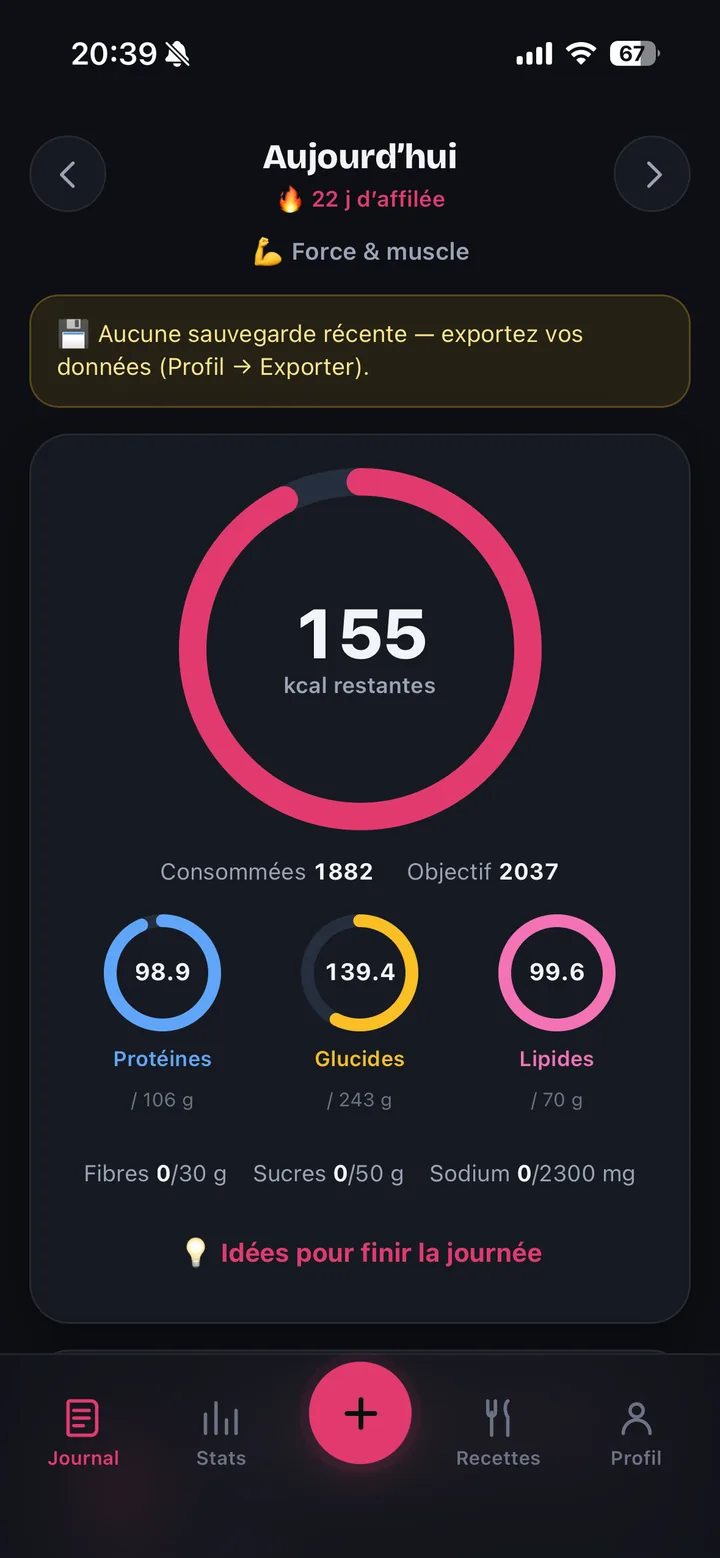
Three tips to keep it simple:
- Aim for ranges, not exact numbers. Being "in the zone" 5 days out of 7 beats one perfect day followed by giving up.
- Start with protein. It's the macro most often too low, and the one that changes satiety the most. The other two tend to fall into place behind it.
- Let an app do the math. Nobody multiplies grams by 4 and 9 in their head at every meal.
Radish shows your three macros automatically for every food you add, with the Nutri-Score right next to it. Everything works counting without a connection, with no account and no ads: your diary stays on your phone — never sent to our servers (except AI or barcode scanning, if you use them), never sold.
FAQ
How many carbs per day?
The ANSES benchmark is 40 to 55% of your calories. On 2,000 kcal, that's 200 to 275 g of carbs a day, favouring whole grains, legumes and fruit over sugars.
What's a macronutrient, in one sentence?
A nutrient your body uses in large amounts to produce energy and build itself: there are three of them, carbohydrates, fat and protein.
Does fat make you gain weight?
Not by itself: it's a calorie surplus that causes weight gain, whatever the source. Fat is simply more calorie-dense (9 kcal/g vs 4), so it's easier to overconsume without realising it.
Should you cut carbs to lose weight?
No. What causes weight loss is a calorie deficit, not the absence of carbs. Cutting sugars and sugary drinks, yes; cutting out starches, rarely useful and rarely sustainable.
Do you need to weigh every food?
No. Weighing a few foods at the start helps calibrate your eye, after which estimates are enough for most people. Consistency of tracking matters more than gram-level precision.
Remember the essentials: carbs 40-55% of calories, fat 35-40%, protein 10-20%, with 4 kcal/g everywhere except fat at 9. Start from your calorie need, secure your protein, and judge your weeks rather than your days. To track all this without a calculator, try Radish, free: nutri-track.fr.
General information, not medical advice. If in doubt or if you have specific needs, talk to a healthcare professional.
🔎 Methodology & sources. Every nutrition figure in this article is cross-checked against official sources (ANSES, EFSA, WHO, CIQUAL/USDA, French Public Health agency), and health topics are reviewed before publication against our internal reference framework. See our full methodology →
Prefer the installed app? Get Radish on iPhone or Android →