CIQUAL, ESTIMATED, RECORDED: what the tag next to each food means
In short
Next to each value, Radish writes a word that states its origin: sourced from an official table (CIQUAL, USDA, CoFID, AUSNUT, BLS, CNF), CALCULATED, LABEL, RECORDED (Open Food Facts), MEASURED by you, ESTIMATED, or QUEUED when the value is waiting for a connection. That word does not judge the food: it says where the figure came from, so you know how far to trust it.
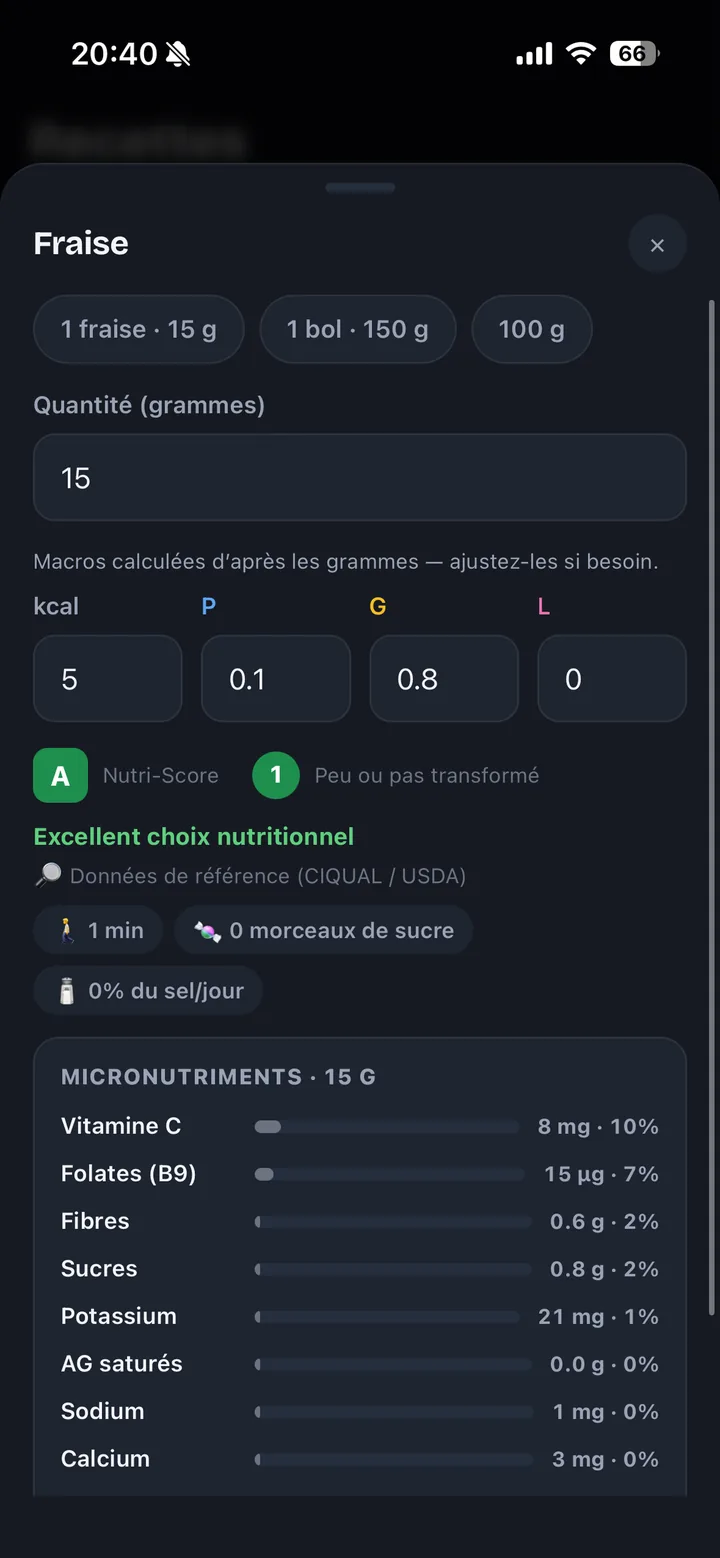
The question comes fast: “214 kcal, fine — but 214 kcal according to whom?” Most calorie counters never answer. Radish shows the answer next to the value, in one word. Here are the seven possible words.
Sourced from an official table
The value is published as such by an official food composition table. Radish names it: CIQUAL (Anses, France), USDA (United States), CoFID (United Kingdom), AUSNUT (Australia), BLS (Germany), CNF (Canada). This is the best case: the food is documented, and the figure comes from published analytical work.
The word used is “sourced”, never “verified”: Radish reuses published values, the app does not run a food-by-food verification.
CALCULATED
The food is documented by an official table, but the energy is not published as such. It is recalculated from the macronutrients of the same record, using the regulatory method of Regulation (EU) 1169/2011, Annex XIV: protein 4 kcal/g, carbohydrate 4, fat 9, fibre 2. The macronutrients themselves do come from the table. The distinction exists because a recalculated energy is not a measured one, even when it is right.
LABEL (USDA)
The figure comes from the manufacturer's label, as submitted to the USDA (“Branded” records in FoodData Central). It is not a laboratory analysis, and we have not checked it. It therefore carries a tag distinct from a CIQUAL record — otherwise a manufacturer's declaration would read as reference data.
RECORDED (Open Food Facts)
The figure comes from the product's Open Food Facts entry, filled in by the community from the packaging. It is not an estimate; nor is it checked by us. This is what you get when you scan a packaged product that isn't in the bundled database.
MEASURED · by you
You entered the value yourself, for instance by copying a label. The app does not present it as an in-house estimate: it is your measurement, and it is identified as such.
ESTIMATED · photo, text or entered
No table behind the figure: it comes from a photo reading, a meal description, or a manual entry with no reference. The second line says which of the three. When a photo reading is too uncertain, the app refuses to write a value rather than offer a wrong one.
QUEUED
The entry was logged with no connection and its value is waiting for the network. It carries a neutral tag rather than borrowing a provenance it does not have yet.
See the source of every foodFree, no account: each value shows its origin and its table code.Download Radish →Why this matters on day three
Because it settles the trust question once. A figure with no origin gets argued about at every meal; a figure that carries its provenance simply gets read. And the diary's CSV export (a Premium feature) carries the same information row by row — origin, CIQUAL or USDA code, “measured” or “estimated”. A value Radish does not have stays an empty cell, never a zero.
The full source methodology, with licences and update dates, is published on the Sources & methodology page.
Frequently asked questions
Why do some foods have no CIQUAL code?
Because they do not come from a composition table: a scanned product, a hand-entered value or an estimate has no code. The tag shown says so, food by food.
Are “sourced” and “verified” the same thing?
No, and the wording is deliberate. Radish reuses values published by official tables; the app does not run a food-by-food analysis. Writing “verified” would imply otherwise.
Is an Open Food Facts value reliable?
It is recorded from the packaging by the Open Food Facts community. It is label data, not a laboratory analysis, and we do not check it — hence its distinct tag.
Can I correct a figure that looks wrong?
At logging time, yes: the quantity sheet lets you edit calories and macros before you confirm. Afterwards, it is the quantity you correct, and the values recompute. A food you create by copying the label of an unknown barcode carries the “measured by you” tag.
Do these sources work without a connection?
The CIQUAL table, the recipes and the Nutri-Score calculation are bundled inside the app: they work with no network. Scanning a product missing from the bundled database does query Open Food Facts.
Want to see those tags for real? Download Radish for iPhone or Android →